 Fund your Account
 Contact Support
 For Institutions
 Honor Elite

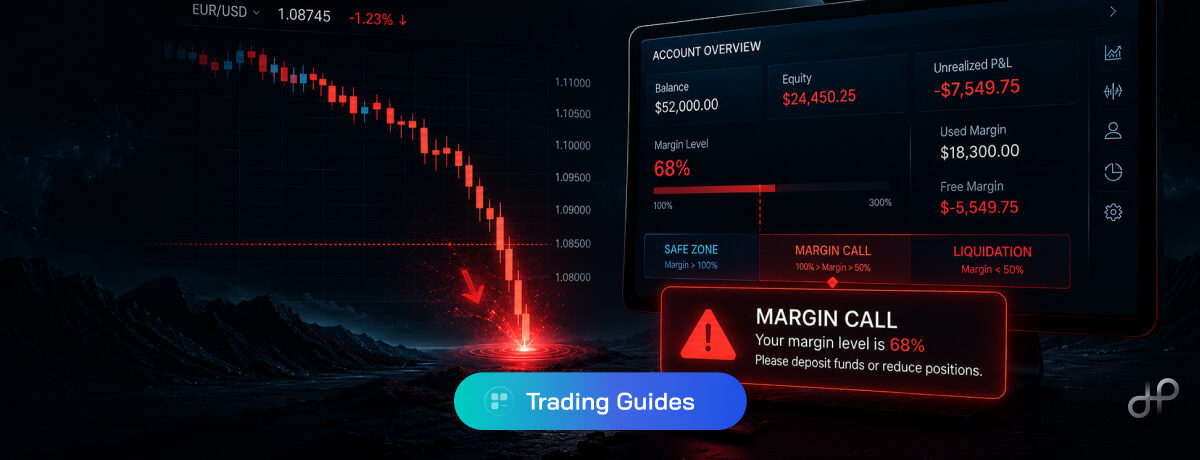
Table of Contents
- What is Margin in Forex?
- How Does Margin Work in Forex Trading?
- What Is a Margin Call and What Triggers One?
- How to Manage Margin and Protect Your Account
- Key Takeaways
- FAQ
What is Margin in Forex?
Margin in forex is a security deposit your broker holds as collateral to keep a leveraged trade open. It is not a fee, and it is not a transaction cost. The broker returns the margin when the position closes, adjusted for any profit or loss made on the trade. Understanding what margin in forex means is the foundation for managing leverage, position sizing, and account risk effectively.
How Does Margin Work in Forex Trading?
Margin works by requiring traders to post a percentage of a position’s full value as collateral, with the broker funding the remainder through leverage. If your broker requires a 2% margin to open a position on EUR/USD, and you want to trade one standard lot, you need to post $2,000 as collateral. The remaining $98,000 is effectively provided by the broker through leverage, which is the ability to control a position larger than your own capital would otherwise allow.
That gap between what you post and what you control is where a few terms become essential:
- Used margin: The portion of your balance currently held as collateral across open trades.
- Free margin: The capital still available to open new positions or absorb losses.
- Equity: Your account balance plus or minus any unrealised profit or loss on open trades.
- Margin level: Expressed as a percentage, calculated as (Equity / Used Margin) x 100.
Your margin level is the number your broker watches closely. It tells them whether your account has enough buffer to keep your trades alive.
When that level falls too low, you get a margin call which is where things get serious.
What is a Margin Call and What Triggers One?
A margin call is a notification from your broker that your account equity has dropped to a point where it can no longer fully cover your open positions. It is not a request. It is a warning that action is required, and fairly quickly.
What Triggers a Forex Margin Call?
Most brokers set a margin call level at around 100% of used margin, though this varies. When your margin level hits that threshold, the broker alerts you to either deposit more funds or close some positions. If you don’t act and the market keeps moving against you, the broker can trigger a stop-out.
A stop-out, sometimes called a forced liquidation, happens when your margin level drops to an even lower threshold, typically around 50%. At that point, the broker automatically closes your most loss-making positions, starting with the largest, until your margin level recovers. You don’t get to choose which trades close.
Margin Call Example
Say you deposit $1,000 and use $500 as margin for a leveraged EUR/USD trade. If the trade moves against you by $450, your equity falls to $550. Your margin level is now (550 / 500) x 100 = 110%. You’re close to the margin call threshold. Another $100 in losses and the alert comes through. Another $250 beyond that, depending on your broker’s stop-out level, and positions start closing automatically, whether you’re watching or not.
Key insight: Margin calls don’t happen because of bad luck alone. They happen because position sizes are too large relative to account equity. Sizing your trades appropriately is the first line of defence.
Why Margin Calls Matter more than Most Traders Realise
High leverage isn’t inherently bad. But using it without tracking your free margin and margin level is how accounts get zeroed out in a matter of hours during volatile sessions. Pretty common, and rarely as dramatic as traders expect until it’s already happened.
How to Manage Margin and Protect Your Account
Understanding margin is one thing. Managing it under live market conditions is something else entirely. These are the practical steps serious traders use:
- Calculate position size before entering. Never open a trade without knowing exactly how much margin it will consume. Most trading platforms include a margin calculator for this reason.
- Keep free margin well above zero. A common rule of thumb is to never let used margin exceed 20 to 30% of your total equity. This gives you room to absorb drawdown without triggering a margin call.
- Use stop-loss orders on every trade. A stop-loss, which is an instruction to automatically close a position at a predetermined price, limits your downside and reduces the chance of a margin call developing faster than you can respond.
- Avoid holding highly leveraged positions overnight. Swap rates, the overnight interest charge on open leveraged positions, compounding your cost exposure, and low-liquidity sessions like the Sydney open can produce sharp, unexpected price moves.
- Monitor your margin level actively. Don’t set it and forget it. Check equity and free margin regularly, especially during major data releases like Non-Farm Payrolls or central bank decisions.
Margin management isn’t about being timid. It’s about staying in the game long enough for your edge to play out. Traders who blow their accounts to margin calls don’t get a second chance on the same trade, and the market won’t wait while you regroup.
The Bottom Line
Margin in forex trading is the mechanism that makes leveraged trading possible, but it carries real risk if you use it without understanding how your equity, used margin, and margin level interact. A margin call is not a punishment. It’s a structural safeguard that your broker enforces when the numbers say your account can’t sustain your open positions.
- Margin defined: A security deposit held by your broker, not a cost or a fee.
- Margin call trigger: Your margin level falls to the broker’s call threshold, typically around 100%.
- Free margin discipline: Keeping adequate free margin is the single most effective way to avoid forced liquidation.
Learn the mechanics, size your positions accordingly, and always trade with a stop-loss in place.
FAQ
Q1. What is the margin in forex?
A. Margin is a portion of your account balance that your broker holds as collateral when you open a leveraged trade. It is not a transaction fee. You get it back when the trade closes, adjusted for profit or loss on the position.
Q2. How is margin level calculated?
A. Margin level is calculated by dividing your equity by your used margin, then multiplying by 100 to get a percentage. A margin level of 200% means your equity is twice the margin currently in use, which indicates a reasonably healthy buffer.
Q3. What happens if I ignore a margin call?
A. If you don’t act, and the market continues moving against your position, your broker will trigger a stop-out. This means the broker forcibly closes your open positions, starting with the most loss-making trade, until your margin level recovers to an acceptable threshold.
Q4. Can I trade forex without understanding the margin?
A. Technically yes, but practically it’s one of the most dangerous approaches a retail trader can take. Misunderstanding margin is one of the primary reasons retail accounts sustain large losses, particularly during volatile sessions when price moves can be sudden and significant.