 Fund your Account
 Contact Support
 For Institutions
 Honor Elite

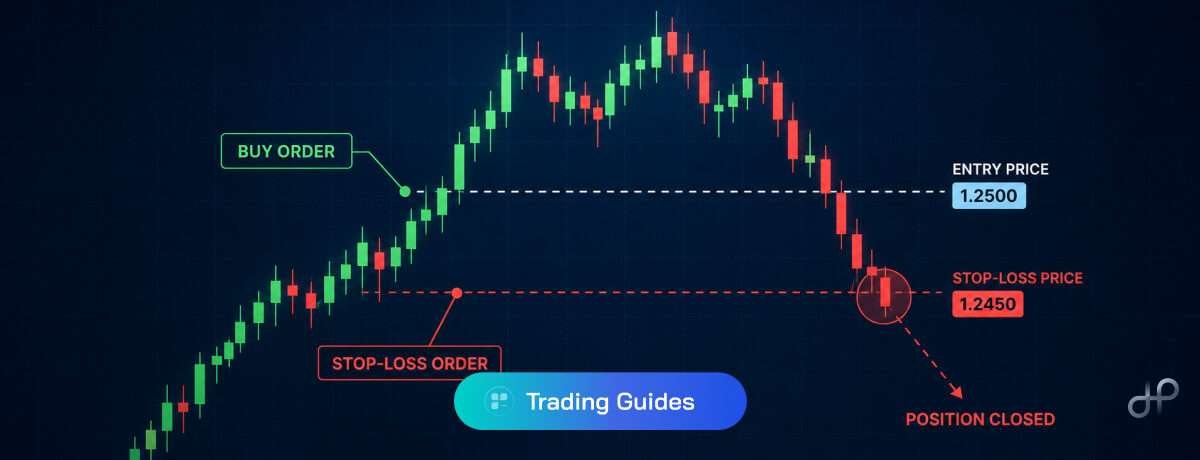
There’s a thin line between a controlled loss and a blown account, and a stop loss order is what separates the two. Most traders know this intellectually, few apply it with any consistency. The market doesn’t wait for you to decide when to exit a losing trade, and every second of hesitation makes the outcome worse. This article covers how stop loss orders actually function in forex and CFD trading, the different types you can use, and three practical placement methods that hold up in live conditions not just in backtests or demo runs.
Table of Contents
- What is a Stop Loss Order?
- How Does a Stop Loss Order Work in Forex Trading?
- What Types of Stop Loss Orders Should Traders Know?
- How Do You Set a Stop Loss? Three Practical Methods
- What Are the Most Common Stop Loss Mistakes?
- Key Takeaways
- FAQ
What is a Stop Loss Order?
A stop loss order is an instruction you give your broker to close a position automatically if price reaches a specified level. No manual intervention needed. No waiting to see if the market recovers.
The purpose is simple. Cap the damage on any single trade before a loss turns into the kind of frustration that pushes you into revenge trading.
Most professional traders don’t treat stop losses as optional. Consistently profitable retail traders report using pre-defined exit rules on every trade, with stop losses being the most commonly cited tool.
How Does a Stop Loss Order Work in Forex Trading?
A stop loss order works by triggering an automatic position close when the market hits your pre-set price level. When you open a trade, you specify that price. If the market reaches it, the broker acts on it immediately.
Here’s a concrete example. You buy EUR/USD at 1.0850, expecting the pair to climb. You place a stop loss at 1.0820. The price drops to 1.0820 and the trade closes, limiting your loss to 30 pips. Without that stop, the temptation to hold and hope for a bounce is real, and losses that could have been contained at 30 pips have a way of turning into 80 or 100.
But there’s a catch worth knowing. A standard stop loss triggers a market order at your stop price, which means the actual fill can land slightly beyond it during fast markets. That gap is called slippage, and in volatile conditions it’s not trivial.
What Types of Stop Loss Orders Should Traders Know?
Not all stop losses work the same way. Choosing the right type for your strategy makes a real difference.
| Types | How it Works | Best Used When |
|---|---|---|
| Fixed Stop Loss | Set at a static price level | You have a defined risk target per trade |
| Trailing Stop Loss | Moves with the price as the trade profits | You want to lock in gains without closing early |
| Guaranteed Stop Loss | Fills exactly at your stop price, no slippage | During high-impact news events or thin liquidity |
| Time-Based Stop | Closes the trade after a set time period | You trade intraday and don’t hold positions overnight |
The trailing stop loss is worth pausing on. Say you go long GBP/USD at 1.2700 and set a trailing stop 40 pips behind the current price. As the trade moves up to 1.2750, the stop automatically rises to 1.2710. It keeps following the price higher, locking in more of the gain as the trade develops. If the price reverses sharply, the stop triggers at whatever level it has trailed to by that point.
For traders managing multiple open positions across different pairs, the quality of a broker’s order management infrastructure matters more than most people realise. HonorPro is built around the kind of fast execution and transparent pricing that becomes important when you’re running conditional orders like trailing stops across several currency pairs at once.
How Do You Set a Stop Loss? Three Practical Methods
There’s no universal formula. Stop loss placement depends on your strategy, the pair you’re trading, and how much the market is moving at a given moment. But three methods cover most situations pretty well.
- The percentage-of-account method
Start by deciding the maximum you’re willing to lose per trade, typically 1% to 2% of your account for disciplined retail traders. Then work backwards to size the position. If your stop is 50 pips away and your account is $10,000, a 1% risk limit means you can absorb a $100 loss on this trade. That figure determines your lot size, not the other way around.
- The technical level method
Place your stop just beyond a meaningful level on the chart: a support or resistance zone, a swing low, a key moving average. The reasoning is straightforward. If price breaks convincingly through that level, the original trade idea is no longer valid. You want to stop sitting past the point where being wrong becomes obvious, not at a level the market can briefly poke through before recovering.
- The Average True Range (ATR) method
ATR measures how much a currency pair typically moves over a set period. Setting your stop at 1.5x to 2x the current ATR gives the trade enough room to breathe without leaving you exposed to a large loss. And because ATR shifts with market conditions, this approach adapts automatically during periods of elevated volatility.
A well-placed stop loss isn’t a sign of nervousness. It’s basic professionalism.
What are the Most Common Stop Loss Mistakes?
Understanding stops in theory and using them well in practice are two different things. These are the errors that come up most often.
- Placing stops too tight. A stop sitting 5 pips away on a pair with an average daily range of 80 pips is going to get hit by ordinary market noise before the trade ever develops. You’ll be stopped out repeatedly on positions that would have worked given a bit more room. The stop has to be wide enough to survive normal price fluctuation, but not so wide it exposes you to a loss that damages the account.
- Moving the stop further away mid-trade. This is the most costly habit in retail trading. Full stop. You set a stop at 1.0820, price approaches it, and you shift it down to 1.0800 because you don’t want to take the loss. You’ve just overridden your own risk management at exactly the moment it was designed to protect you. The stop loss exists precisely because in-the-moment decisions during a losing trade are almost always the wrong ones.
- Ignoring volatility. A stop that’s well-sized on a quiet Tuesday can be completely inadequate during a central bank rate announcement. Check the economic calendar before entering trades. Around major scheduled events, consider wider stops, smaller position sizes, or simply waiting for the dust to settle before taking a position.
Key Habbit: Check every stop placement against the current ATR before confirming the trade. It takes about 30 seconds and it pays for itself quickly.
Key Takeaways
A stop loss order is one of the most practical risk management tools available to any forex or CFD trader, regardless of experience level. Setting one on every trade is not a sign of uncertainty – it’s a sign of discipline.
- Fixed stops: Define your maximum loss per trade before emotions enter the picture.
- Trailing stops: Lock in profits automatically as the market moves in your favour.
- Stop placement: Use ATR or technical levels, not arbitrary round numbers.
- Consistency: The traders who manage risk well over time are the ones who treat the stop loss as mandatory, not optional.
As market volatility remains elevated through 2025 and into 2026, disciplined use of stop losses will continue to separate traders who survive drawdowns from those who don’t.
FAQ
Q1. Can a stop loss order guarantee I won’t lose more than the set amount?
A. Not always. In fast-moving markets, slippage can cause your trade to close at a worse price than your stop level. Guaranteed stop loss orders remove this risk but usually carry an additional cost. For most standard conditions, a regular stop loss performs as expected.
Q2. Where should I place my stop loss in forex trading?
A. Place it at a level that invalidates your trade idea, just beyond a key support or resistance level, or at 1.5x to 2x the current ATR. Avoid placing stops at obvious round numbers where many other traders cluster their orders.
Q3. Does using a stop loss mean I’ll lose money more often?
A. No. A stop loss limits losses on individual trades, but it doesn’t change your win rate. What it does is prevent a single bad trade from destroying a large portion of your account, which is what allows you to keep trading over the long term.
Q4. What is a trailing stop loss and when should I use it?
A. A trailing stop moves automatically as the price moves in your favour, locking in profit while keeping the trade open. It works best in trending markets where you want to capture as much of a move as possible without manually adjusting your exit.