 Fund your Account
 Contact Support
 For Institutions
 Honor Elite

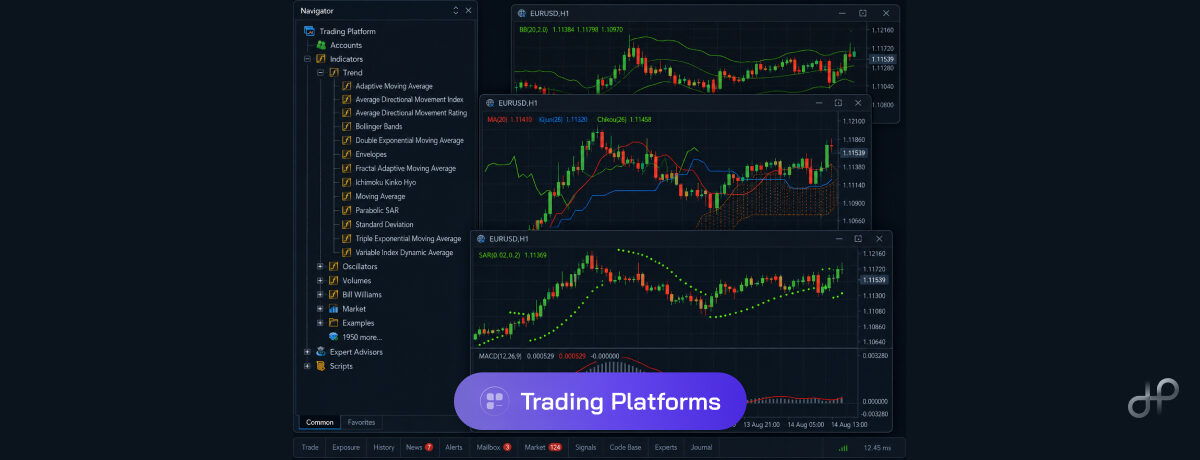
Most traders load their charts with too many tools, second-guess every signal, and still can’t explain what half their indicators actually measure. Knowing the best MT5 indicators available in MetaTrader 5 isn’t just a technical shortcut. It’s how you stop reacting to noise and start reading markets with some actual clarity. This article covers the most reliable built-in tools, how each one works in practice, and how to match them to your trading style. No crowded-chart advice. Just what works.
Table of Contents
- What are MT5 Indicators and Why Do They Matter?
- The Best MT5 Indicators for Trend Trading
- Momentum and Oscillator Indicators for MT5
- Volume and Volatility Indicators Worth Using
- How to Choose the Right MT5 Indicators for Your Style
- Conclusion
- FAQ
What are MT5 Indicators and Why Do They Matter?
MetaTrader 5 indicators are mathematical calculations plotted directly on your price chart or in a separate panel below it. They process historical price data, volume, or both to give you a visual read on market conditions, whether that’s trend direction, momentum strength, or potential reversal zones.
Indicators do not predict the future. What they do is structure the information already present in price and volume so you can make more informed decisions. A raw price chart gives you raw data. Indicators give you context.
And that context matters more than most beginners expect. The depth of MT5’s native indicator library is a big part of why platform adoption stays high among retail traders globally. But more indicators on your chart doesn’t mean better analysis. Not even close. The traders who get the most out of MT5 are those who understand a small set of tools deeply, rather than layering ten signals on top of each other and hoping something sticks.
The Best MT5 Indicators for Trend Trading
Trend trading is built on one simple principle: trade in the direction the market is already moving. These indicators help you identify that direction and stay in it long enough to matter.
1. Moving Averages
The Moving Average (MA) smooths out price fluctuations over a set number of periods, giving you a cleaner line that reflects the underlying direction. MT5 offers four types: Simple (SMA), Exponential (EMA), Smoothed, and Linear Weighted.
The Exponential Moving Average gives more weight to recent price data, which makes it more responsive to current conditions. Traders commonly watch the 50-period and 200-period EMAs. When the shorter crosses above the longer, that’s typically read as a bullish signal. When price consistently trades above the 200 EMA, the broader trend is considered upward.
That setup is straightforward enough, but where traders tend to go wrong is treating the crossover as an entry signal on its own. It’s a filter, not a trigger.
2. Ichimoku Kinko Hyo
Ichimoku is more complex but genuinely powerful. It plots multiple lines simultaneously, including support and resistance zones projected into the future, current momentum, and trend direction, all from a single indicator. If you trade higher time frames, Ichimoku rewards the learning curve.
Tip: On MT5, you can overlay the Ichimoku cloud directly on your chart. A price trading above the cloud signals an uptrend; below it signals a downtrend. The cloud itself acts as dynamic support or resistance.
Momentum and Oscillator Indicators for MT5
Once you know the trend direction, momentum indicators help you time your entries and spot potential reversals before they fully develop. Think of them as a second opinion on what the trend indicators are already telling you.
1. Relative Strength Index (RSI)
The RSI (Relative Strength Index) measures the speed and magnitude of recent price changes on a scale from 0 to 100. Readings above 70 are typically interpreted as overbought; readings below 30 suggest oversold conditions. On MT5, the default period is 14, which works pretty well across most timeframes.
You might be wondering whether overbought simply means sell. It doesn’t. That’s one of the most common misreadings of RSI, and it catches a lot of newer traders off guard. In a strong uptrend, RSI can stay above 70 for extended periods without a meaningful pullback. Use it instead to look for divergence, where price makes a new high but RSI doesn’t follow, as a more reliable reversal signal.
2. MACD (Moving Average Convergence Divergence)
The MACD tracks the relationship between two EMAs, typically the 12-period and 26-period, and plots the difference as a histogram. When the MACD line crosses above the signal line, traders read that as bullish momentum building. When it crosses below, momentum is shifting downward.
MACD is particularly useful when combined with a trend filter like a moving average. Trading MACD signals in the direction of the dominant trend dramatically reduces false entries, which is the kind of practical edge that makes a real difference over a large sample of trades.
Volume and Volatility Indicators Worth Using
Trend and momentum indicators tell you where price is going and how fast. Volume and volatility indicators tell you how much conviction is actually behind that move. Without that layer, you’re reading direction without understanding force.
1. Bollinger Bands
Bollinger Bands consist of a central moving average and two outer bands plotted two standard deviations away from it. When the bands contract in what’s called a squeeze, the market is consolidating and volatility is low. When price breaks out of a squeeze with expanding bands, that breakout carries more statistical weight than one that comes out of nowhere.
Bollinger Bands remain among the most widely used technical indicators by active retail traders across MT5 and MT4 platforms. Their continued relevance reflects how effectively they frame price moves within volatility context, rather than in isolation.
2. Average True Range (ATR)
The ATR (Average True Range) measures how much a currency pair typically moves over a given period, expressed in pips (the smallest standardised price movement, usually 0.0001 for most major pairs). ATR doesn’t signal direction. It signals magnitude.
Use ATR to set realistic stop-loss levels. If EUR/USD has an ATR of 80 pips on the daily chart, placing your stop 15 pips away is almost certainly too tight, and the market will take it out before your thesis even has a chance to play out. Position sizing and stop placement rooted in ATR tend to survive market noise better than fixed-pip approaches, particularly during high-volatility sessions.
How to Choose the Right MT5 Indicators for Your Style
There’s no one-size-fits-all answer here. The best forex indicators for MT5 are the ones that match your timeframe, your trading style, and your willingness to sit with uncertainty while a setup develops.
| Indicator | Type | Best For | Timeframe Suitability |
|---|---|---|---|
| EMA (50/200) | Trend | Trend direction filtering | All timeframes |
| RSI (14) | Momentum | Overbought/oversold timing | M15 to Daily |
| MACD | Momentum | Entry confirmation | H1 to Daily |
| Bollinger Bands | Volatility | Breakout and squeeze setups | M30 to Weekly |
| ATR | Volatility | Stop-loss sizing | All timeframes |
| Ichimoku | Trend/Support | Multi-signal trend analysis | H4 to Weekly |
A few practical rules that experienced traders apply when building a setup:
- Combine indicator types: Use one trend indicator alongside one momentum indicator rather than two trend tools. They complement instead of duplicate each other.
- Avoid redundancy: RSI and Stochastic are both oscillators measuring similar things. Pairing them adds clutter, not insight.
- Match to your timeframe: Shorter timeframes generate more noise. On anything below H1, indicators respond to random fluctuations as readily as real signals.
Brokers and platforms that cater to active traders often support custom indicator deployment alongside the native MT5 library. HonorPro, for example, supports full MT5 platform functionality with fast execution and direct market access, which matters when you’re acting on indicator signals in fast-moving currency pairs.
And let’s be honest: even the best MT5 indicator setup fails if your execution environment is unreliable. Signal quality and execution quality are both parts of the same trade outcome. You can’t separate them.
Conclusion
Selecting and applying the right MetaTrader 5 indicators is less about collecting tools and more about understanding what each one actually tells you. Use fewer indicators with genuine depth rather than layering signals you barely understand.
Trend indicators like Moving Averages and Ichimoku identify direction, so always know the dominant trend before entering a trade. Momentum tools like RSI and MACD help time your entries and flag divergence, and they work best when used in the direction of the prevailing trend. Volatility indicators such as Bollinger Bands and ATR frame how much a move means and how far your stops should sit.
When selecting tools, match them to your timeframe and combine different indicator types rather than duplicates. Study how each indicator behaves under different market conditions before committing real capital to any setup built around it.
FAQ
Q1. What are the best MT5 indicators for beginners?
A. Start with the 50 and 200 EMA for trend direction, RSI for momentum, and ATR for stop-loss sizing. These three tools cover the core information you need without overcomplicating your chart. Master them individually before combining them.
Q2. Can I add custom indicators to MetaTrader 5?
A. Yes. MT5 supports custom indicators written in MQL5, its native programming language. You can download third-party indicators from the MetaTrader Market or import MQL5 files manually through the platform’s data folder. Always test custom indicators on a demo account first.
Q3. How many indicators should I use on one chart?
A. Most experienced traders use two to three indicators maximum. One trend tool, one momentum tool, and one volatility reference is a solid baseline. More than three typically creates signal conflicts that slow decision-making rather than improving it.
Q4. Is RSI reliable for forex trading on MT5?
A. RSI is reliable as a supporting tool, not a standalone signal. On MT5, it works well for identifying divergence and confirming entries in trending markets. Do not use RSI readings in isolation — always context-check them against the prevailing trend and price structure.